How to Add and Subtract in Scientific Notation
How to Add and Subtract in Scientific Notation
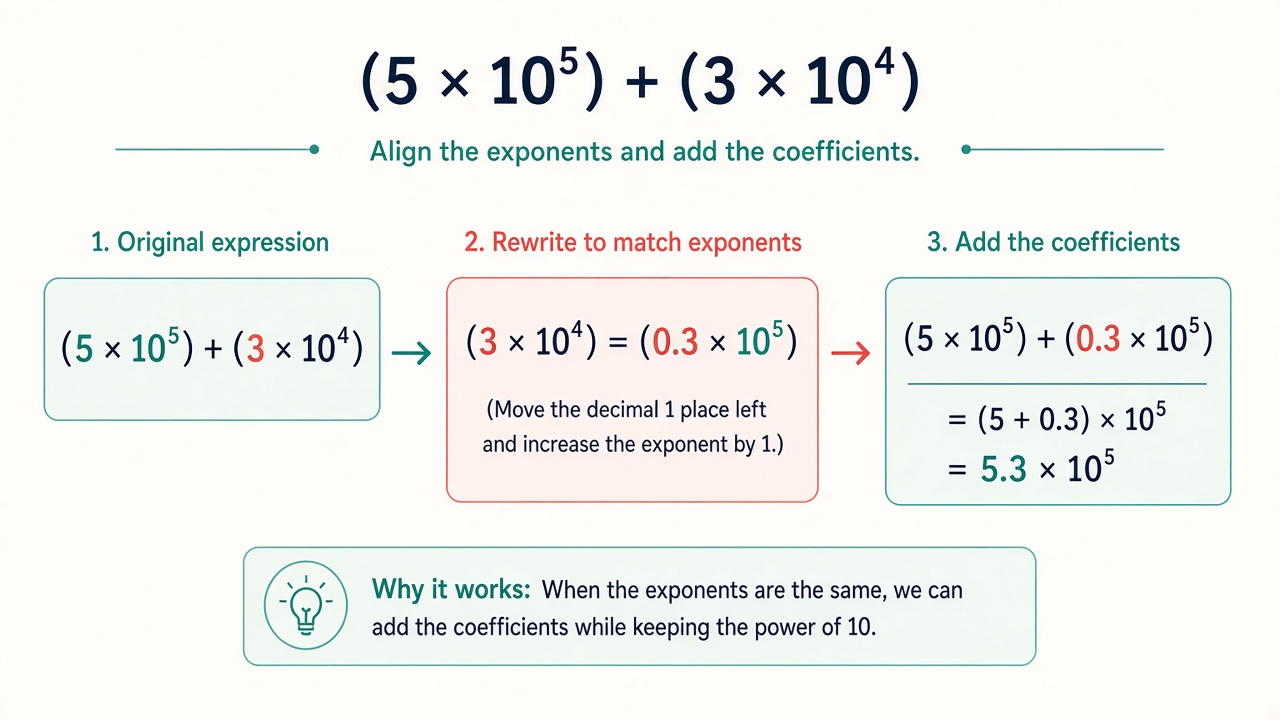
To add or subtract in scientific notation, first make the exponents the same, then add or subtract the coefficients and keep the common exponent. To add 5 × 10⁵ and 3 × 10⁴, rewrite the second number as 0.3 × 10⁵, then add the coefficients: 5 + 0.3 = 5.3, so the result is 5.3 × 10⁵. Renormalize the result if the coefficient falls outside the range 1 to 10.
Addition and subtraction are the two scientific-notation operations that need the exponents to match, unlike multiplication and division. The Scientific Notation Calculator performs these operations and shows each step. This guide covers why the exponents must match and how to keep the answer in correct form.
Why the Exponents Must Match
Addition and subtraction combine like place values, so the two numbers must sit on the same scale before their coefficients can be added. A value times 10⁵ and a value times 10⁴ are ten times apart in scale, and adding their coefficients directly would combine numbers of different sizes. Matching the exponents is the same idea as lining up decimal points before adding ordinary numbers.
Multiplication and division work differently, because they scale rather than combine. To multiply, you multiply the coefficients and add the exponents; to divide, you divide the coefficients and subtract the exponents. Neither needs the exponents to match first. That is why addition and subtraction are the operations that require the extra matching step.
How to Add in Scientific Notation Step by Step
Add two numbers in scientific notation in 3 steps:
- Make the exponents equal by rewriting the number with the smaller exponent, moving its decimal to raise the exponent to match.
- Add the coefficients, keeping the common power of 10.
- Renormalize if the coefficient is 10 or larger, or less than 1.
To add 4.2 × 10³ and 5 × 10², rewrite the second number as 0.5 × 10³ so both share 10³. Then 4.2 + 0.5 = 4.7, so the result is 4.7 × 10³. The coefficient sits between 1 and 10, so the answer is already in normalized form.
How to Subtract in Scientific Notation
Subtraction follows the same rule as addition: match the exponents, subtract the coefficients, and keep the exponent. To subtract 3 × 10⁶ from 8 × 10⁶, the exponents already match, so subtract the coefficients: 8 − 3 = 5, so the result is 5 × 10⁶.
When the exponents differ, adjust one number first. To subtract 6 × 10⁴ from 2 × 10⁵, rewrite the first number as 20 × 10⁴, or rewrite the second as 0.6 × 10⁵. Using 10⁵, the calculation is 2 − 0.6 = 1.4, so the result is 1.4 × 10⁵. The scientific notation converter helps rewrite a number to a chosen exponent before subtracting.
How to Renormalize the Result
A sum or difference sometimes leaves a coefficient outside the range 1 to 10, and renormalizing fixes it. When the coefficient is 10 or larger, move the decimal one place left and raise the exponent by 1: adding 7 × 10⁴ and 5 × 10⁴ gives 12 × 10⁴, which renormalizes to 1.2 × 10⁵.
When the coefficient is less than 1, move the decimal right and lower the exponent. Subtracting 4.8 × 10³ from 5 × 10³ gives 0.2 × 10³, which renormalizes to 2 × 10². Renormalizing keeps every answer in standard scientific-notation form, the same form covered in the guide on how to convert a number to scientific notation.
Worked Example: Adding Two Measurements
A distance of 3.5 × 10⁶ meters is joined to a distance of 4.2 × 10⁵ meters. Find the total in scientific notation.
- Match the exponents: rewrite 4.2 × 10⁵ as 0.42 × 10⁶ so both use 10⁶.
- Add the coefficients: 3.5 + 0.42 = 3.92.
- Keep the exponent: the total is 3.92 × 10⁶ meters.
The coefficient 3.92 sits between 1 and 10, so no renormalizing is needed, and the total is 3.92 × 10⁶ meters. Converting both numbers to the same exponent before adding makes the coefficients directly comparable.
Key Takeaways
- To add or subtract in scientific notation, make the exponents match first, then add or subtract the coefficients.
- Keep the common exponent in the result; only the coefficients are combined.
- Matching exponents puts both numbers on the same scale, like aligning decimal points.
- Renormalize when the coefficient leaves the range 1 to 10: 12 × 10⁴ becomes 1.2 × 10⁵.
- Multiplication and division do not need matching exponents; only addition and subtraction do.
Frequently Asked Questions
How do you add numbers in scientific notation?
Make the exponents the same, then add the coefficients and keep the common exponent. To add 5 times 10⁵ and 3 times 10⁴, rewrite the second as 0.3 times 10⁵, then add the coefficients: 5 plus 0.3 is 5.3, so the result is 5.3 times 10⁵. Renormalize if the coefficient falls outside 1 to 10.
Why do exponents need to match to add scientific notation?
Exponents must match because addition combines like place values. A number times 10⁵ and a number times 10⁴ sit on different size scales, so their coefficients cannot be added directly. Equal exponents put both numbers on the same scale, the same idea as lining up decimal points before adding.
How do you subtract in scientific notation?
Subtract in scientific notation the same way as addition: make the exponents match, subtract the coefficients, and keep the exponent. To subtract 3 times 10⁶ from 8 times 10⁶, subtract the coefficients: 8 minus 3 is 5, so the result is 5 times 10⁶. Renormalize the result if the coefficient falls below 1.
What does it mean to renormalize scientific notation?
Renormalizing means adjusting the result so the coefficient is at least 1 and less than 10. If adding gives 12 times 10⁴, rewrite it as 1.2 times 10⁵ by moving the decimal one place left and raising the exponent by 1. If it gives 0.5 times 10⁴, rewrite it as 5 times 10³.
Do you need the same exponent to multiply scientific notation?
No. Multiplication and division do not require matching exponents. To multiply, multiply the coefficients and add the exponents; to divide, divide the coefficients and subtract the exponents. Only addition and subtraction need the exponents to match first, because those operations combine like scales.
Conclusion
To add or subtract in scientific notation, match the exponents, then combine the coefficients and keep the exponent. Rewrite the number with the smaller exponent so both share a scale, add or subtract the coefficients, and renormalize if the result leaves the range 1 to 10. Work through any calculation with the Scientific Notation Calculator.
Ready to run the numbers? Use the Scientific Notation Calculator.