How to Convert a Number to Scientific Notation
How to Convert a Number to Scientific Notation
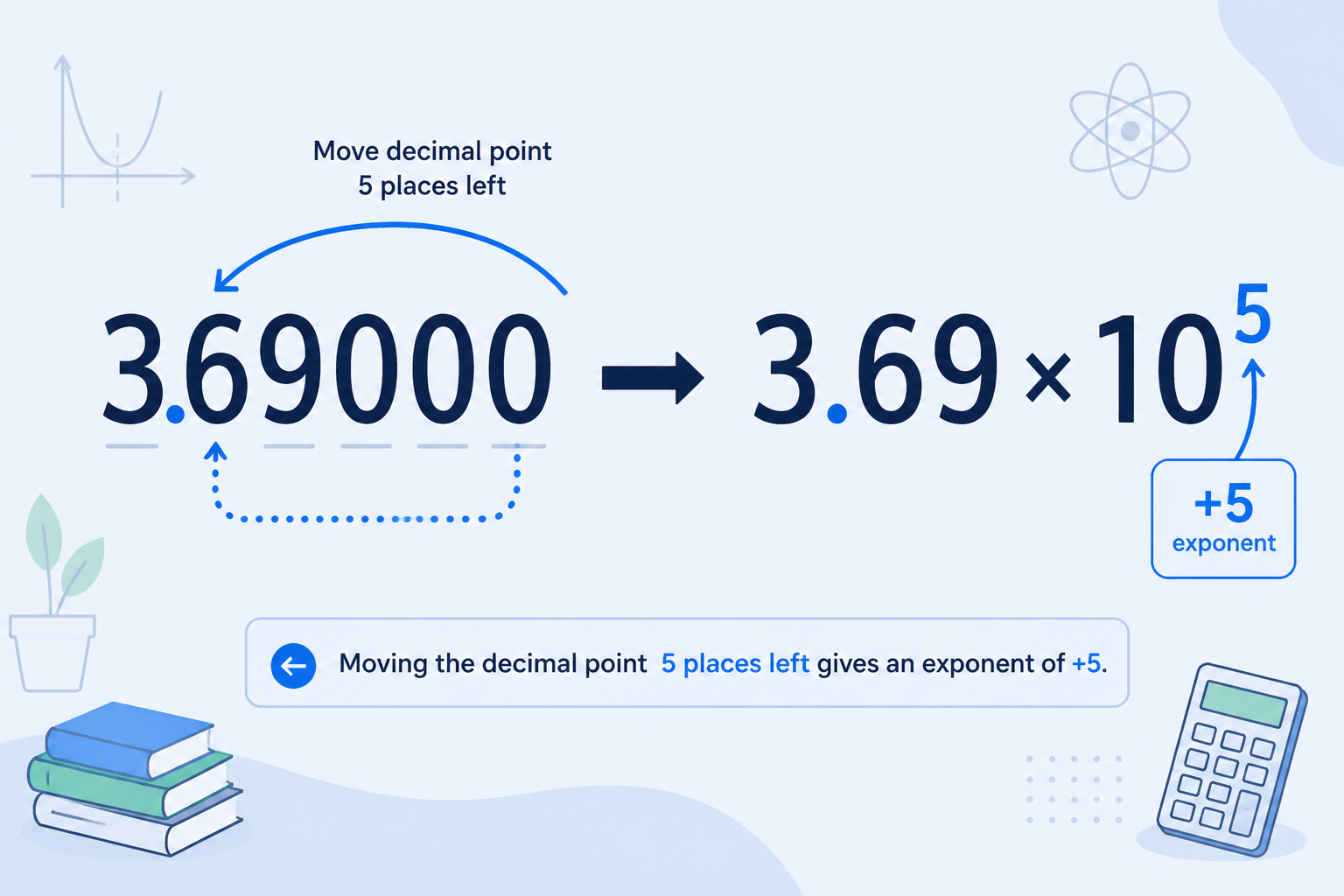
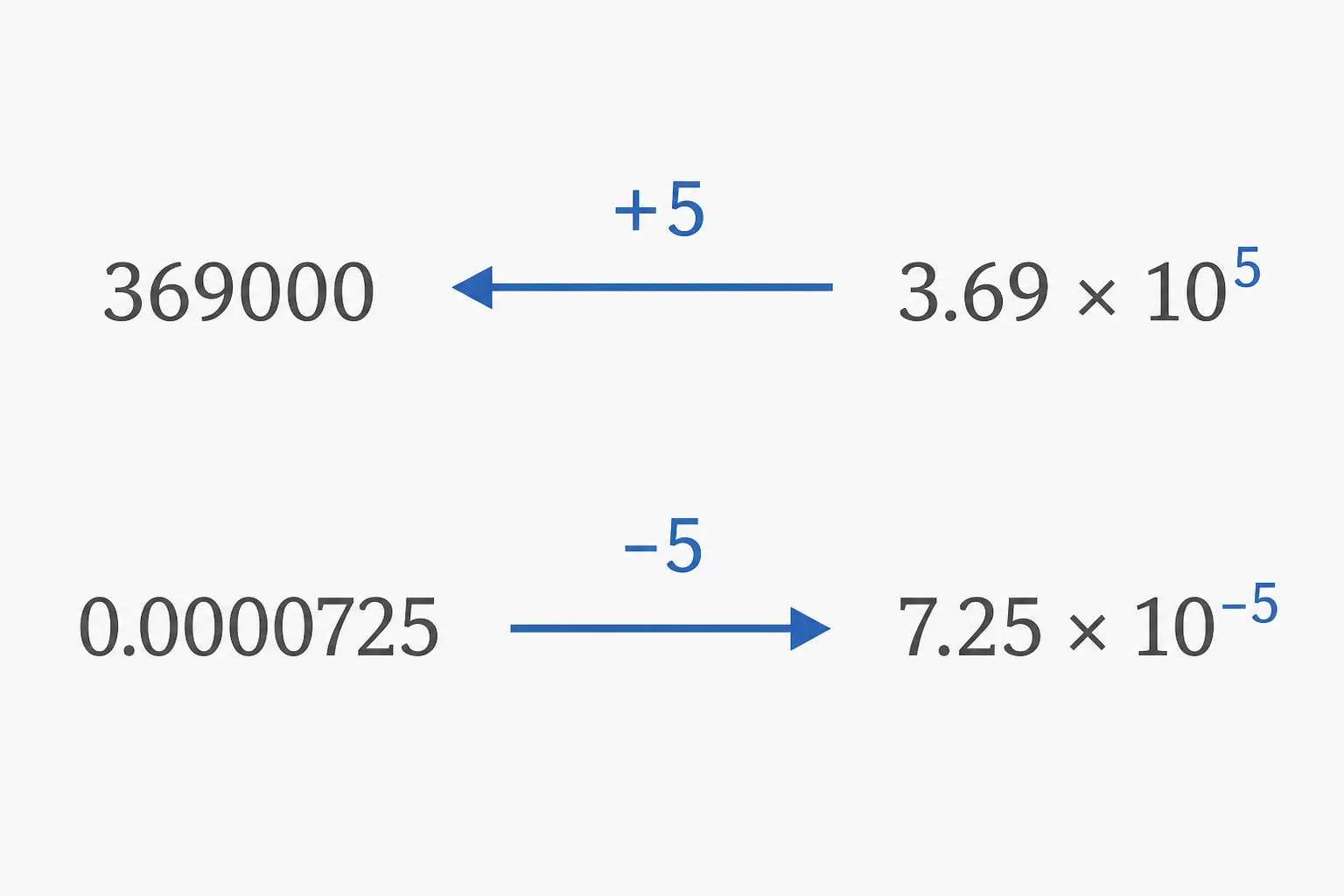
Convert a number to scientific notation by writing it as a coefficient between 1 and 10 multiplied by a power of 10. Move the decimal point until one non-zero digit remains to its left, and count the places moved. That count is the exponent: positive for numbers greater than 10, negative for numbers below 1. The number 369,000 becomes 3.69 × 10⁵, and 0.0000725 becomes 7.25 × 10⁻⁵.
Scientific notation writes very large and very small values in a compact form, which makes them easier to read, compare, and calculate. The Scientific Notation Calculator converts any number and shows the exponent, but the method below explains each step so a converted value is correct by hand.
The Scientific Notation Form
Scientific notation has one form: a × 10ⁿ, where the coefficient a is at least 1 and less than 10, and the exponent n is an integer. The coefficient holds the significant digits of the number, and the power of 10 records the size. This is called normalized scientific notation, because the coefficient sits in the single range 1 to 10.
A value such as 36.5 × 10⁴ is mathematically correct but not normalized, because 36.5 is greater than 10. The normalized form is 3.65 × 10⁵. Normalizing keeps one non-zero digit before the decimal point, so every number has one standard scientific-notation form.
How to Convert a Large Number
Convert a large number to scientific notation in 3 steps:
- Place the decimal point after the first non-zero digit to form the coefficient.
- Count how many places the decimal point moved from its original position.
- Write the coefficient times 10 raised to that count, with a positive exponent.
For 369,000, the decimal point starts after the final zero. Move it left to sit after the 3, which gives the coefficient 3.69. The decimal moved 5 places, so the exponent is 5, and the result is 3.69 × 10⁵. Drop the trailing zeros, because the power of 10 records the size instead.
How to Convert a Small Number
Convert a small number to scientific notation the same way, with a negative exponent:
- Move the decimal point right until one non-zero digit sits before it.
- Count the places the decimal point moved.
- Write the coefficient times 10 raised to the negative of that count.
For 0.0000725, move the decimal point right until it sits after the 7, which gives the coefficient 7.25. The decimal moved 5 places, so the exponent is −5, and the result is 7.25 × 10⁻⁵. A negative exponent marks a value below 1, and the decimal to scientific converter applies this rule to any decimal.
Worked Examples
The table below converts four numbers using the same rule. The direction and size of the exponent follow the decimal move.
| Standard number | Coefficient | Decimal move | Scientific notation |
|---|---|---|---|
| 122,500 | 1.225 | 5 left | 1.225 × 10⁵ |
| 741 | 7.41 | 2 left | 7.41 × 10² |
| 0.001 | 1 | 3 right | 1 × 10⁻³ |
| 0.0000725 | 7.25 | 5 right | 7.25 × 10⁻⁵ |
Each conversion keeps the significant digits in the coefficient and records the size in the exponent. A left move gives a positive exponent, and a right move gives a negative exponent.
How to Convert Scientific Notation Back to Standard Form
Convert scientific notation back to standard form by moving the decimal point by the number of places the exponent shows. Move the decimal right for a positive exponent and left for a negative exponent, adding zeros where needed. The value 4.2 × 10³ becomes 4,200, and the value 7.25 × 10⁻⁵ becomes 0.0000725.
A positive exponent produces a number larger than the coefficient, and a negative exponent produces a number smaller than 1. Standard form is also called the real-number or decimal value, and it is the everyday way of writing the same quantity.
Scientific Notation, E Notation, and Engineering Notation
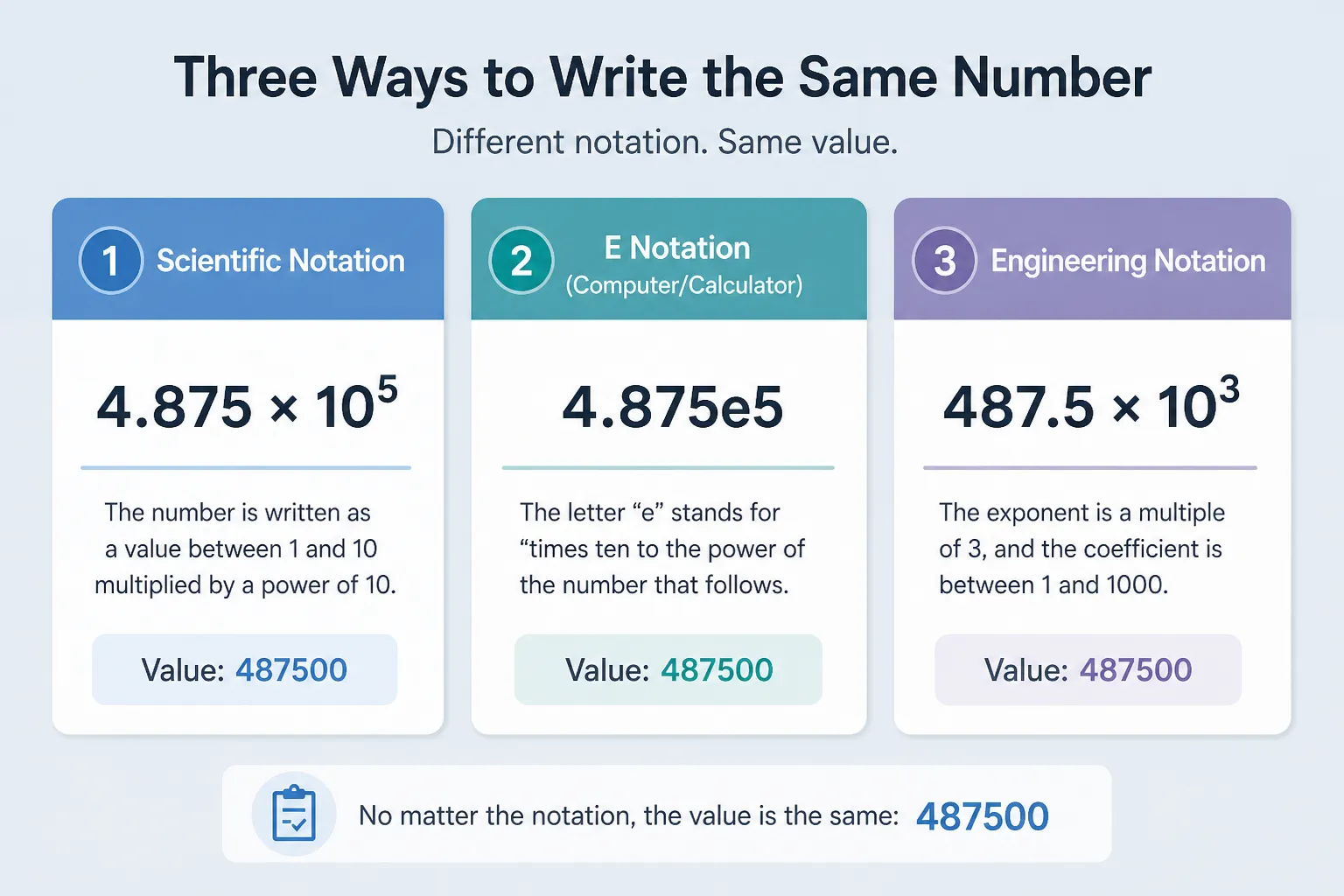
The same value appears in three related formats. Scientific notation writes a coefficient times a power of 10. E notation replaces × 10ⁿ with the letter e, so 4.875 × 10⁵ becomes 4.875e5, a format calculators and software accept as typed input. Engineering notation restricts the exponent to multiples of three, so the same value reads 487.5 × 10³, which matches the SI prefixes kilo, mega, and milli.
Three formats suit three needs: scientific notation for math and science writing, E notation for typed input, and engineering notation for units with metric prefixes. The E notation converter and the engineering notation converter switch a value between these forms without changing its size.
Significant Figures in Scientific Notation
Significant figures are counted from the coefficient, not from the exponent. In 4.70 × 10³, the value has 3 significant figures, because the coefficient 4.70 holds three significant digits. The trailing zero after the decimal point counts, and the exponent never changes the count.
Scientific notation makes significant figures clear, because only the meaningful digits appear in the coefficient. A measured value of 4,700 with two significant figures is written 4.7 × 10³, which removes the ambiguity that trailing zeros create in standard form. The significant figures calculator counts the digits in any coefficient.
Common Mistakes When Converting to Scientific Notation
Three common mistakes appear when converting to scientific notation:
- Leaving a coefficient of 10 or greater, such as 36.5 × 10⁴, which is not normalized.
- Using the wrong exponent sign, giving a large number a negative exponent or a small number a positive one.
- Miscounting the decimal places, which shifts the exponent by one.
Two further errors change the value. Dropping a significant digit from the coefficient loses precision, so keep every meaningful digit. Adding the trailing zeros back into the coefficient defeats the purpose of the notation, because the power of 10 already records the size. Paste any number into the Scientific Notation Calculator to confirm the coefficient and exponent.
Frequently Asked Questions
How do you convert a number to scientific notation?
Write the number as a coefficient between 1 and 10 multiplied by a power of 10. Move the decimal point until one non-zero digit remains to its left. The number of places moved is the exponent: positive for large numbers, negative for numbers below 1.
What is the coefficient in scientific notation?
The coefficient, also called the significand, is the number written before the power of 10. In normalized scientific notation it is at least 1 and less than 10. In 3.69 × 10⁵, the coefficient is 3.69 and the power of 10 is 10⁵.
How do you convert a small number to scientific notation?
Move the decimal point to the right until one non-zero digit sits before it, and make the exponent negative. The number of places moved is the size of the negative exponent. 0.0000725 becomes 7.25 × 10⁻⁵, because the decimal moves 5 places right.
What is the difference between scientific notation and E notation?
Scientific notation and E notation represent the same value. Scientific notation writes a coefficient times 10 to a power, such as 6.022 × 10²³. E notation replaces × 10ⁿ with the letter e, giving 6.022e23. E notation is used in calculators and software input fields.
How do you convert scientific notation back to standard form?
Move the decimal point by the number of places the exponent shows. Move right for a positive exponent and left for a negative exponent, adding zeros as needed. 4.2 × 10³ becomes 4,200, and 7.25 × 10⁻⁵ becomes 0.0000725.
Ready to run the numbers? Use the Scientific Notation Calculator.