Scientific Notation to Standard Form: Steps & Examples
How to Convert Scientific Notation to Standard Form
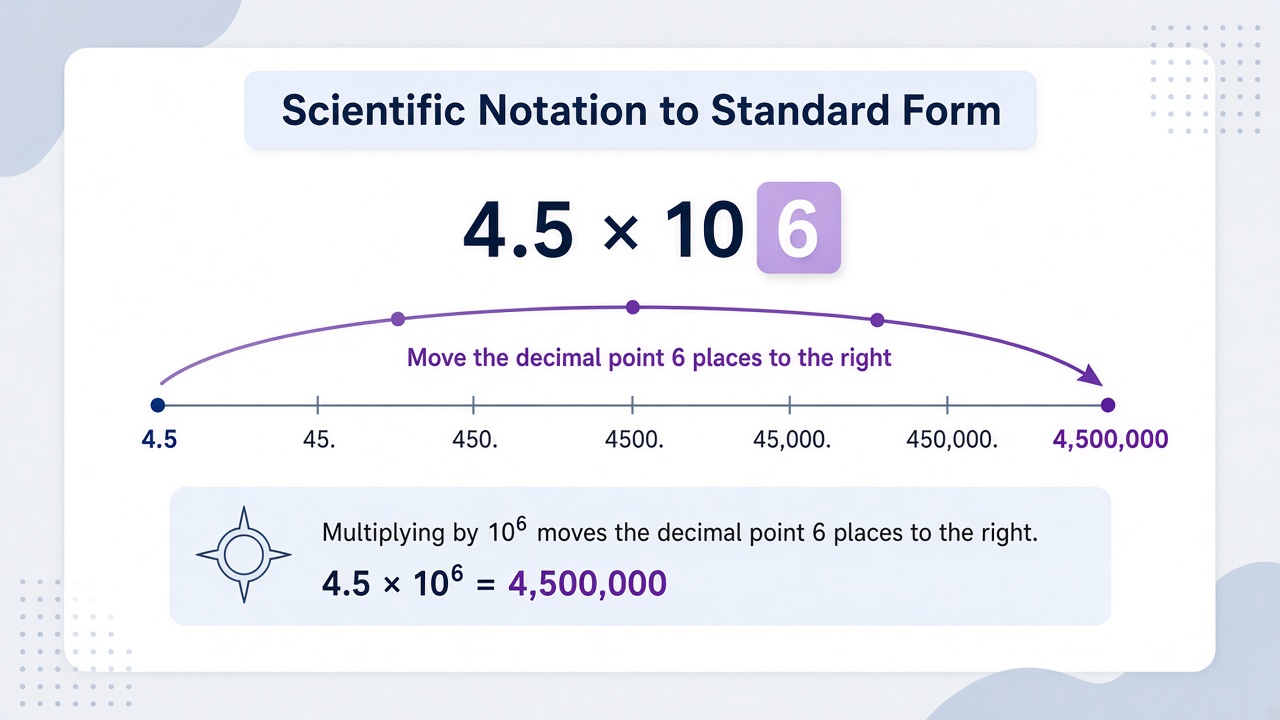
To convert scientific notation to standard form, move the decimal point in the coefficient by the number of places the exponent shows. Move the decimal right for a positive exponent and left for a negative exponent, and fill empty places with zeros. The value 4.5 × 10⁶ becomes 4,500,000, and 3.2 × 10⁻⁴ becomes 0.00032.
Standard form is the ordinary way of writing a number with all of its digits, so this conversion expands the compact scientific-notation form back into a full decimal. The Scientific Notation Calculator shows the standard-form result for any input, and this guide walks through the decimal move so you can expand a value by hand.
What Standard Form Means
Standard form, also called standard notation or decimal form, writes a number with every digit in place, such as 93,000,000 or 0.00045. Scientific notation writes the same value as a coefficient between 1 and 10 multiplied by a power of 10. Converting from scientific notation to standard form removes the exponent and restores the full number.
The exponent tells you how to convert. A positive exponent means the number is large, so the decimal moves right to make a big whole number. A negative exponent means the number is smaller than 1, so the decimal moves left to make a small decimal. The sign sets the direction; the size sets the distance.
How to Convert Step by Step
Convert scientific notation to standard form in 3 steps:
- Read the exponent and note its sign, which sets the direction of the decimal move.
- Move the decimal point in the coefficient by the number of places the exponent shows.
- Fill any empty positions with zeros, adding them after the digits for a positive exponent or before them for a negative one.
For 6.7 × 10³, the exponent is positive 3, so move the decimal 3 places right: 6.7 becomes 6,700, with two zeros filling the empty places. The coefficient already has one digit past the decimal, so only two extra zeros are needed to finish the three-place move.
Converting a Positive Exponent
A positive exponent produces a whole number larger than the coefficient. Move the decimal to the right, and add zeros to fill places beyond the coefficient’s digits. For 4.5 × 10⁶, move the decimal 6 places right. The coefficient supplies one place (the 5), so five zeros complete the move: 4,500,000.
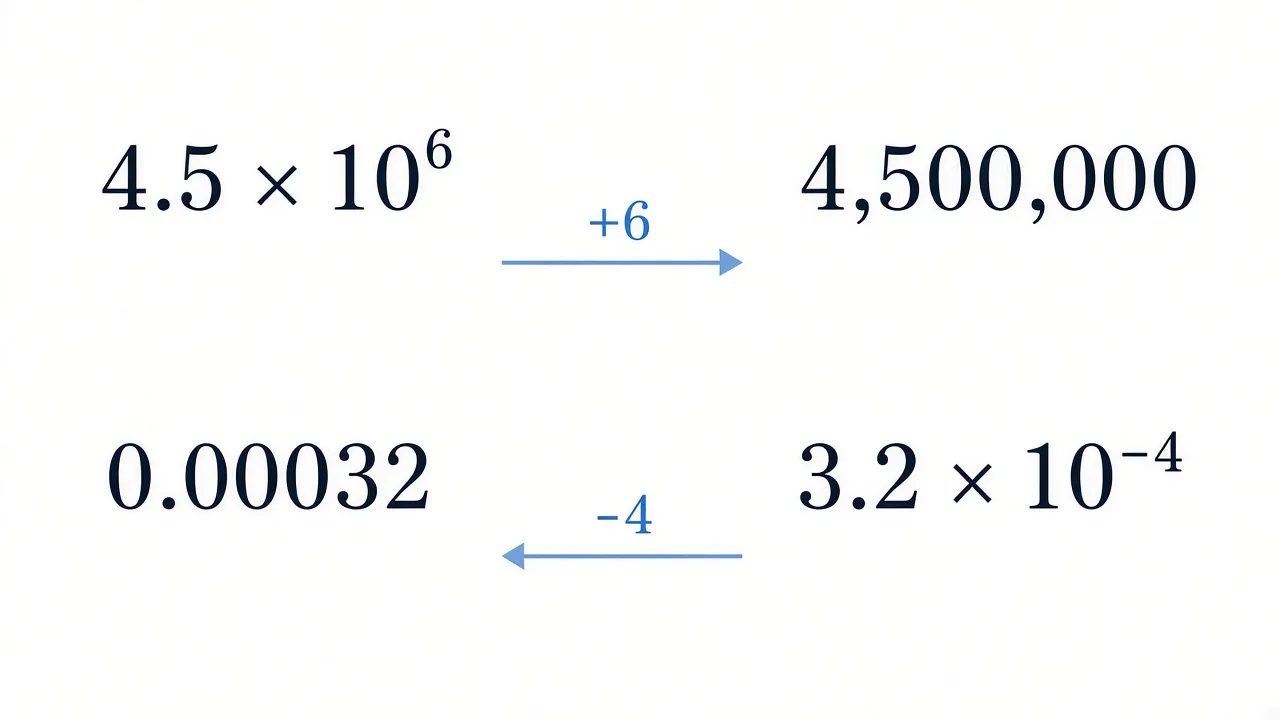
The exponent equals the total number of places the decimal moves, not the number of zeros added. That distinction prevents the common error of writing one zero too many. In 4.5 × 10⁶, the decimal moves 6 places, but only 5 zeros appear, because the digit 5 occupies one of the six positions.
Converting a Negative Exponent
A negative exponent produces a number smaller than 1. Move the decimal to the left, and add leading zeros between the decimal point and the coefficient. For 3.2 × 10⁻⁴, move the decimal 4 places left: the result is 0.00032, with three zeros between the decimal point and the 3.
Count the total move as the exponent size, including the position the first digit lands in. In 3.2 × 10⁻⁴, the decimal moves 4 places left, and the digits 3 and 2 occupy the fourth and fifth positions after the point. The decimal to scientific converter runs this process in reverse, turning a small decimal back into scientific notation.
Scientific Notation to Standard Form Chart
The chart converts common values in both directions of the exponent. Each result moves the decimal by the exponent shown.
| Scientific notation | Exponent | Decimal move | Standard form |
|---|---|---|---|
| 1.0 × 10³ | +3 | 3 right | 1,000 |
| 4.5 × 10⁶ | +6 | 6 right | 4,500,000 |
| 9.11 × 10⁻¹ | −1 | 1 left | 0.911 |
| 3.2 × 10⁻⁴ | −4 | 4 left | 0.00032 |
| 6.022 × 10²³ | +23 | 23 right | 602,200,000,000,000,000,000,000 |
The chart shows how quickly the digit count grows with the exponent. An exponent of 23 produces a 24-digit whole number, which is why scientific notation is used for values this large.
How to Convert E Notation to Standard Form
E notation replaces × 10 to a power with the letter e, so 6.022e23 means 6.022 × 10²³. Convert it to standard form the same way: read the number after the e as the exponent, then move the decimal that many places. For 6.022e23, move the decimal 23 places right.
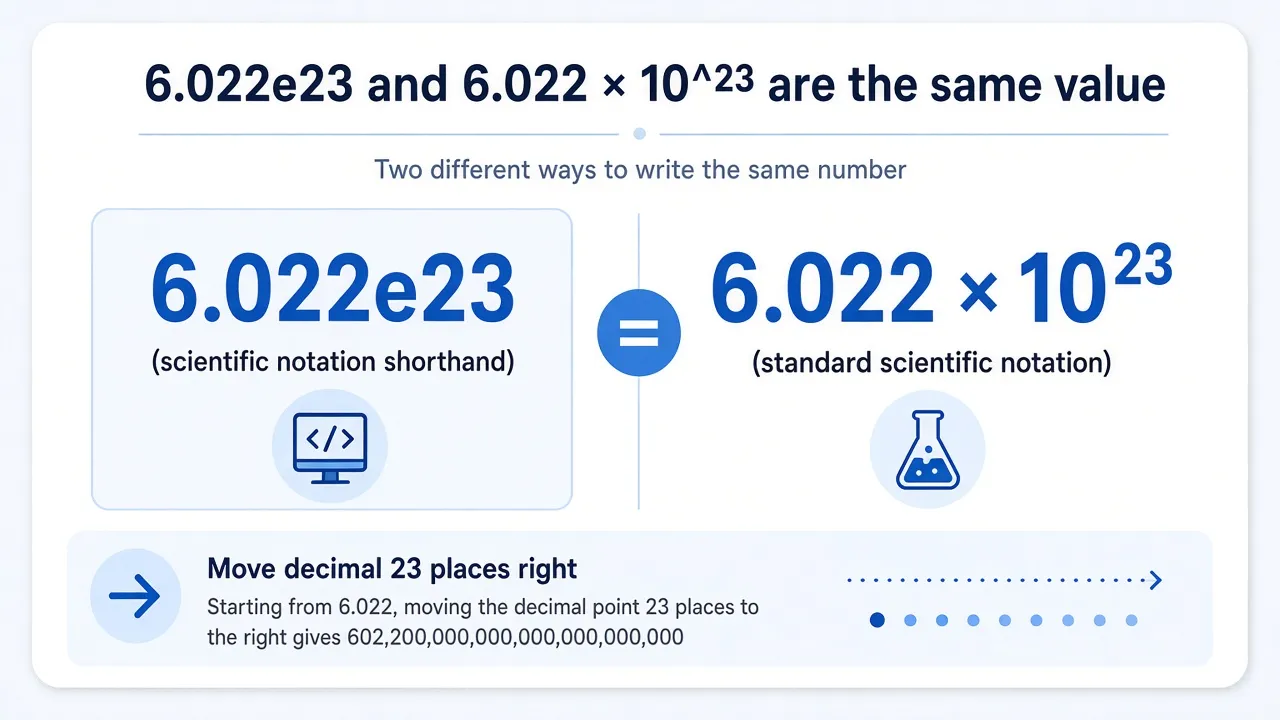
E notation appears on calculators and in software because it is easier to type than a superscript exponent. The value is identical to scientific notation, so the conversion rule does not change. The scientific notation converter reads e notation, decimal input, and × 10 exponent format, and returns the standard form for each. The reverse direction, standard form back to scientific notation, is covered in how to convert a number to scientific notation.
Frequently Asked Questions
How do you convert scientific notation to standard form?
Move the decimal point in the coefficient by the number of places the exponent shows. Move it right for a positive exponent and left for a negative exponent, filling empty places with zeros. For 4.5 × 10⁶, move the decimal 6 places right to get 4,500,000. For 3.2 × 10⁻⁴, move it 4 places left to get 0.00032.
What is standard form of a number?
Standard form, also called standard notation or the decimal form, is the ordinary way of writing a number with all its digits, such as 4,500,000 or 0.00032. It is the opposite of scientific notation, which compresses the same value into a coefficient times a power of 10. Standard form shows the full number without exponents.
Which way do you move the decimal in scientific notation?
Move the decimal right when the exponent is positive, because a positive exponent makes the number larger. Move it left when the exponent is negative, because a negative exponent makes the number smaller than 1. The size of the exponent tells you how many places to move, and you add zeros to fill any empty positions.
How do you convert E notation to standard form?
Read the number after the letter e as the exponent, then move the decimal that many places. E notation is the same as scientific notation with × 10 to a power replaced by e. For 6.022e23, treat it as 6.022 × 10²³ and move the decimal 23 places right, which produces a 24-digit whole number.
How do you convert a negative exponent to standard form?
Move the decimal point left by the size of the negative exponent, adding leading zeros before the coefficient. A negative exponent always produces a number smaller than 1. For 7.25 × 10⁻⁵, move the decimal 5 places left to get 0.0000725, where four zeros sit between the decimal point and the 7.
Ready to run the numbers? Use the Scientific Notation Calculator.